Share Kiro credits across your team with credit pooling
Kiro’s new credit pooling model gives enterprise engineering teams shared credits, granular governance, and usage flexibility for predictable AI spend.
Shweta V A
Product
Ranjith Ramakrishnan
Product
Krishna Parab
Product Marketing
As AI coding tools become an increasingly important part of software development, AI credit usage is rapidly growing. But AI usage is not uniform across developers and teams. Individual subscriptions that allocate credits uniformly do not align with how teams consume credits. This leads to inefficient credit usage and unpredictable monthly invoices. For many organizations, managing AI costs has become the main concern heading into budget planning.
Sound familiar? You are not alone. Here are a few scenarios you may encounter:
- A handful of power users consume most credits while light users let their credits expire unused.
- AI agents rack up unexpected charges overnight before anyone notices.
- Individual seat licenses create billing silos. Unused credits in one group can’t cover extra usage in another.
- There is no easy way to enforce usage limits.
Teams need a more flexible way to purchase, share, govern, and predict AI consumption. Today, we are addressing that directly. Credit pooling delivers cost efficiency, governance, and usage flexibility for predictable AI spend, with billing through your AWS account. It is now available for Kiro Enterprise customers, giving teams a smarter, more economical way to share and govern AI access.
Credit pooling is an enterprise pricing model for Kiro that lets your organization share a single pool of Kiro credits across your entire team. Credits are added to a shared pool that everyone draws from, so your power users can access the capacity that lighter users don’t need. Admins can still set a usage limit for each user, and that usage is drawn from the shared pool. Credit pooling comes with centralized purchasing, visibility, and governance. Billing runs through your AWS account, so Kiro charges show up with the rest of your AWS spend.
- $20 per seat per month, minimum two seats. The seat fee and the 500 credits each seat adds to the pool are both pro-rated in the first month for mid-cycle additions, based on the days left in the billing cycle.
- 500 credits included per seat, contributed to the shared pool for each billing cycle. These reset monthly.
- Add-on credits at $0.04 each, added to the pool instantly when purchased. Purchased credits roll over for up to 12 months, so you can buy capacity in a single procurement cycle and plan further ahead.
- Smart credit consumption. Your team uses included credits first, then purchased credits, starting with those closest to expiration. One team’s surplus protects another team’s crunch.
- No double-billing: If a user belongs to multiple groups, your organization pays only for one seat.
Credit pooling enables real cost savings, better governance, and more flexibility for AI use.
The core value of credit pooling is simple. In any team, AI usage is not uniform. Developers may use more credits when deep in a sprint than when focused on code reviews. When credits are tied to individual seats, the light users’ credits remain unused while the heavy users run short and need more. Pooling reduces inefficiency. When credits are shared, the natural variation in usage across team members works in your favor. One team’s surplus covers another team’s crunch.
Example: A company purchases 20 seats and gets 10,000 included credits per month in the shared pool. Engineering (9), Design (5), and Data Science (6) team members all draw from the same pool. Without credit pooling, three developers who rarely use AI coding tools may leave their 1,500 combined included credits (500 per seat) unused each month, and others who exhaust their included credits may need to purchase add-on credits. With credit pooling, those 1,500 credits added to the pool flow automatically to the power users running complex refactoring to be used before they need to request add-on credits. No manual rebalancing is required.
In addition to natural load-balancing, organizations that actively manage group-level procurement see further savings by reducing the need for emergency credit purchases and right-sizing pool capacity to actual team usage patterns.
Credit pooling also works as a governance system. Kiro gives administrators the controls they need to manage AI usage the same way they manage any other enterprise resource, with clear policies, real-time enforcement, and automated guardrails.
Administrators can set usage limits at three levels; profile-level, group-level, and individual level; in increasing order of precedence. For users in multiple groups, the highest group limit applies in favor of the user. When developers hit their limits, further usage is blocked until the administrator purchases additional credits, so there are no surprise charges at month-end.
Kiro sends configurable alerts to administrators when credit utilization reaches defined thresholds. By default, alerts fire at 80% and 100% for credit usage against each user’s limit, pool credit limit, and seat utilization levels as assigned versus purchased seats. Admins stay ahead of depletion.
Seat reconciliation is automatic. Groups can be created manually or populated via AWS IAM Identity Center (IDC). Group management via 3rd-party identity providers will be available soon. Mid-cycle seat additions are handled seamlessly, with credits added to the pool immediately. When users leave or change roles, seat assignments update without billing disruption.
API access to these controls is coming soon, so you can manage governance programmatically.
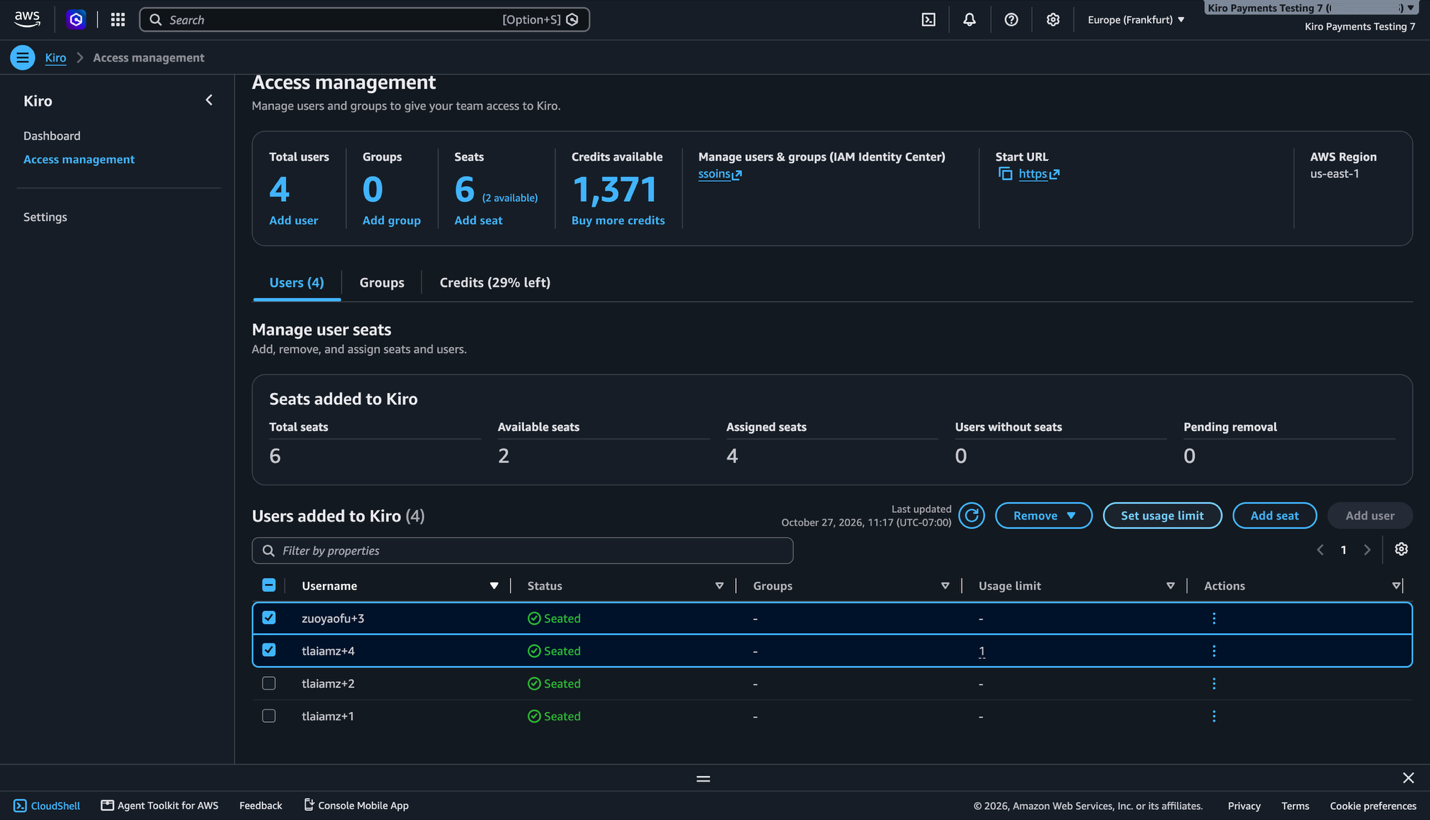
You can’t manage what you can’t measure. Credit pooling gives administrators a real-time view of AI spend at every level of the organization and flexibility to adjust spend as usage evolves.
Pool-level dashboards show a view of total credits available, consumed, and remaining across the entire organization. With seat utilization tracking, you can see which seats are underutilized, so you can right-size your pool.
With credit pooling, you can accommodate changing usage patterns without continually adjusting individual subscriptions or allowances. Group-level usage trends help you plan for the long term. Because purchased credits last up to 12 months, you can buy add-on credits for a pool strategically.
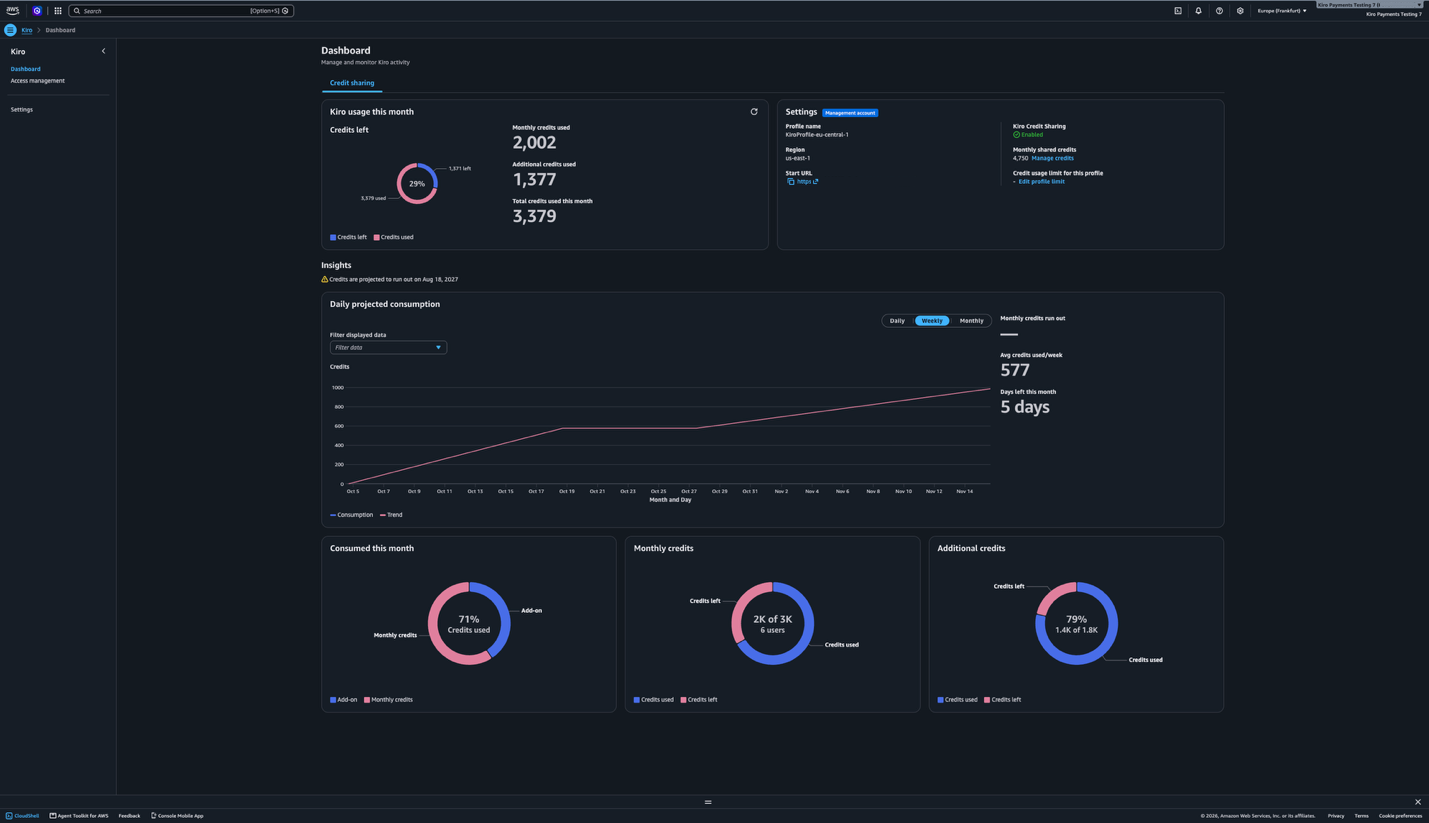
Credit pooling gives enterprise engineering teams the three things they have been asking for: better cost efficiency through shared credits, centralized governance with granular controls, and usage flexibility for predictable AI spend across teams.
Here is what you get with credit pooling:
- Cost efficiency: Reduce or eliminate wasted credits from light users. Let your power users draw on the full team pool.
- Governance depth: Set usage limits at the profile, group, and individual levels.
- Planning confidence: Usage dashboards and threshold alerts help you avoid surprises at the end of the month.
- Enterprise trust: AWS-native billing integration and AWS IDC-based group management support trust for enterprise-wide AI use.
Ready to start sharing credits across your team? Credit pooling is the default for new Kiro Enterprise customers, and existing Enterprise customers can opt in when they are ready. Visit Pricing to explore credit pooling for your team or contact us to set up a pilot. For detailed setup instructions, see the docs.