GPT‑5.6 is now available in Kiro
OpenAI models are available in Kiro for the first time — and we couldn't think of a better way to mark the occasion. This launch also marks one year of Kiro: since public preview on July 14, 2025, Kiro has grown from a spec-driven IDE into a full agentic development platform spanning the IDE, CLI, and Web.
Starting today, GPT‑5.6 Sol, Terra, and Luna are live across Kiro IDE, CLI, and Web — three tiers of frontier intelligence, each tuned for a different point on the performance-cost curve. Bringing OpenAI models alongside Anthropic's is the latest step in that evolution — and a fitting way to celebrate year one.
GPT‑5.6 is built around a simple idea: stronger intelligence shouldn't cost more than the task requires. Sol, Terra, and Luna give you direct control over that tradeoff — from maximum capability to maximum efficiency.
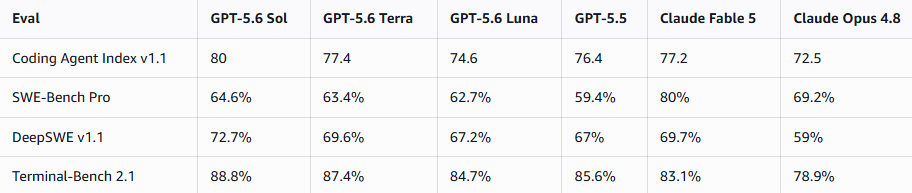
GPT‑5.6 Sol is the flagship. It sets a new state of the art on the Coding Agent Index (80) and Terminal-Bench 2.1 (88.8%) — above Claude Fable 5 on both — while using less than half the output tokens and taking less than half the time. For the hardest multi-step work — spec-driven implementation, long-horizon refactors, complex terminal tasks — Sol is built to finish.
GPT‑5.6 Terra is the balanced option. It scores 77.4 on the Coding Agent Index — just above Claude Fable 5's 77.2 — at a fraction of the cost. Strong performance for everyday agentic work without paying flagship prices.
GPT‑5.6 Luna is the most cost-efficient tier. It outperforms Claude Opus 4.8 on the Coding Agent Index (74.6 vs. 72.5) at approximately one-quarter the cost of Sol. More runs, more tasks, more throughput.
Across the IDE, CLI, and Web, GPT‑5.6 runs longer without supervision and manages its own tool use more efficiently. It can write and run lightweight programs that coordinate tools and process intermediate results as it goes — reducing round-trips, cutting unnecessary tokens, and finishing complex tasks with less guidance.
For spec-driven workflows in the IDE, this translates to higher-fidelity implementation with less drift. For the CLI and Web, multi-step tasks — browsing, terminal use, multi-file refactors — run to completion more reliably with fewer dead ends.
GPT‑5.6 Sol, Terra, and Luna are rolling out gradually with experimental support to Kiro Pro, Pro+, Pro Max, and Power customers with Kiro profiles in US East (N. Virginia) or Europe (Frankfurt). All three models ship with a 272K context window. GPT‑5.6 Sol carries a 2.4x credit multiplier, Terra a 1.2x multiplier, and Luna a 0.6x multiplier.
For organizations with data residency requirements. All three models have a Global inference scope and use global cross-region inference. Requests may be processed in supported commercial AWS Regions worldwide, including Regions outside your Kiro profile's geography. Global routing does not change where Kiro stores your content. Their Experimental lifecycle status does not cause this routing; see the Inference endpoint regions table for each model's scope and endpoint.
A note on GPT‑5.6 in Kiro: these models use a hidden chain-of-thought reasoning process. You won't see the model's internal reasoning steps — only the final output. This is expected behavior and does not affect output quality.
Restart the IDE or CLI to check for the latest available models. Web users can refresh their browser to see GPT‑5.6 Sol, Terra, and Luna in the model selector.