Building a software factory around human attention
Our journey to automate with agents started with one agent on one task in someone’s session. Now we’re moving toward agents working autonomously across the whole software development lifecycle, from triage and exploration through design, implementation, release and monitoring. Many teams building with agents are heading the same way, and people have started calling where it leads a software factory. There’s no settled definition, and no single setup fits every team. The bottlenecks they hit are much the same, though, so we’re sharing ours.
We’re the team that builds the agent inside Kiro, and smarter agents alone didn’t get us there. After a year of building Kiro, our agents got faster at writing code than we got at reviewing it. Pull requests got bigger and arrived faster, and each one often has to answer every question at once: Does it work, or where does it break? Is this the right approach? Is this even the right problem? The more of the lifecycle we automate, the tighter the code review bottleneck gets, and a team is left either letting reviews pile up or skimming them.
Design reviews help, but people can’t hold one for every change at this pace, and the implementation keeps changing after them. Review agents and well-crafted skills get you part of the way. Reviewing well takes an understanding of the codebase and evolving team practices, which is too broad to cover, depends on context outside the repo, and is hard to keep current. Everyone on the team has also set up their agent harness a little differently, which is good for trying things out but doesn’t give the whole team one bar to count on. The people who know where the complexity hides end up holding the line in review, and some nights they lie awake wondering whether what they let ship that day was right.
The limit on how much we can hand to agents is human attention. As our frontier engineering guide puts it, the work is deciding what needs your attention and what does not. So we built our software factory around where and how it’s spent. It takes on the task management, context gathering and coordination, and leaves people to focus on the decisions that matter most. We get more of the lifecycle automated, and reviews a person can keep up with. The factory asks for a person only where one is needed, and gives them enough to decide when it does. We can’t write down everything a good reviewer knows up front, so the factory also captures every correction a person makes and uses it to improve itself. Over time that will show us where less attention is safe.
Our factory turns items on the team’s task board into released changes. Agents do each step, and a person comes in where a decision is needed. Each step of the lifecycle has its own worker, an agent that runs on a schedule, on a host the whole team shares, and picks up items where the previous step left them. Every worker runs a verification loop for its step and leaves verifiable output a person can review before the work moves on or audit later.
Our factory is a layer on top of an agent harness, and that layer runs the whole lifecycle. It looks for work on its own, with nobody starting a session, and learning is built in. Many of us already capture what we learn in our harness, with memory and with custom skills. Skills checked into the repo reach the whole team, but someone has to notice the lesson and write it down, so it only covers what they chose to save. The factory learns from the entire team directly. Every correction anyone makes is already on the board item or the pull request, and each time the Learn step runs, it reads them all and proposes changes to the existing skills.
We wrote down how we run our factory as a set of prompts and skills, which we call the Manual, and we’re open-sourcing it. To set it up, a team writes an instance: its own configuration and skills on top of the Manual. The instance connects the Manual to the team’s repo, board and hosting. An instance can also define a goal that drives its behavior and feeds every learning cycle.
The factory alleviates the attention problem in three ways. It spreads the decisions across the lifecycle, makes each review easier, and reduces the context switches you don’t need.
A submitted pull request shouldn’t be the first place anyone asks whether a change is worth making. So we modeled the steps of the software development lifecycle based on the way our team organizes its work. Every work item passes through these stages, and each one settles part of that question before the item moves on.
- Discover puts new work on the task board.
- Triage reads the code and settles what the problem is and who needs to weigh in, whether that’s an engineer, product or a designer, so nobody opens a pull request wondering whether to do it at all.
- Design writes a spec when a change needs one, for a person to approve where the team requires it.
- Implement builds the change with tests, checks it against the spec and works through review comments and CI itself, so a reviewer first sees the change when it’s ready for a person.
- Release manages getting the change out to users.
- Monitor checks whether it helped, watching what the item and the team’s instance point it to, and follows up when something’s off.
- Learn refines the skills every step runs on.
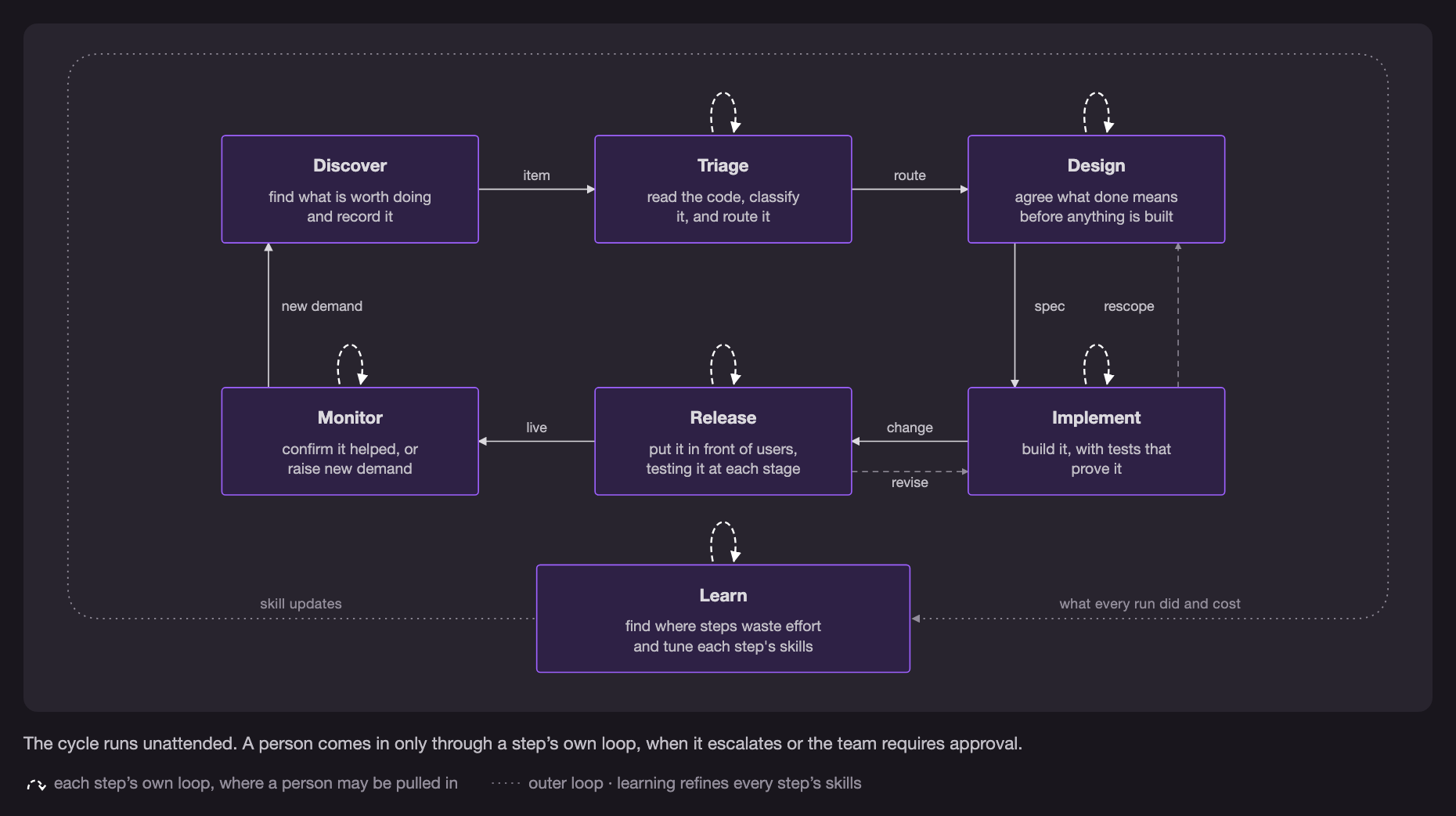
You don’t have to check a step you can rely on. Trust comes from the whole process as well as the final output, and the pull request stops being the one place that has to catch everything.
Spreading the decisions out only helps if each one is quick to make, so the factory tries to hand reviewers something easy to check.
Every step checks its own work, whether it’s writing a triage note, a spec or a change. It produces a candidate and checks it against the signals the team trusts, from the build and tests to review agents and the practices we’ve agreed on. If the candidate meets the bar, the step is done. If it doesn’t, the step takes another pass or tries a different approach. If it keeps churning, which is how a small fix turns into a subsystem, it stops trying. It settles the choice itself when an ordinary change could undo it, and asks a person only when the choice is hard to undo. Every change meets the same bar, so reviewers know what to expect, and when someone’s experiment in their own setup works, they can turn it into a factory skill so everyone gets it.
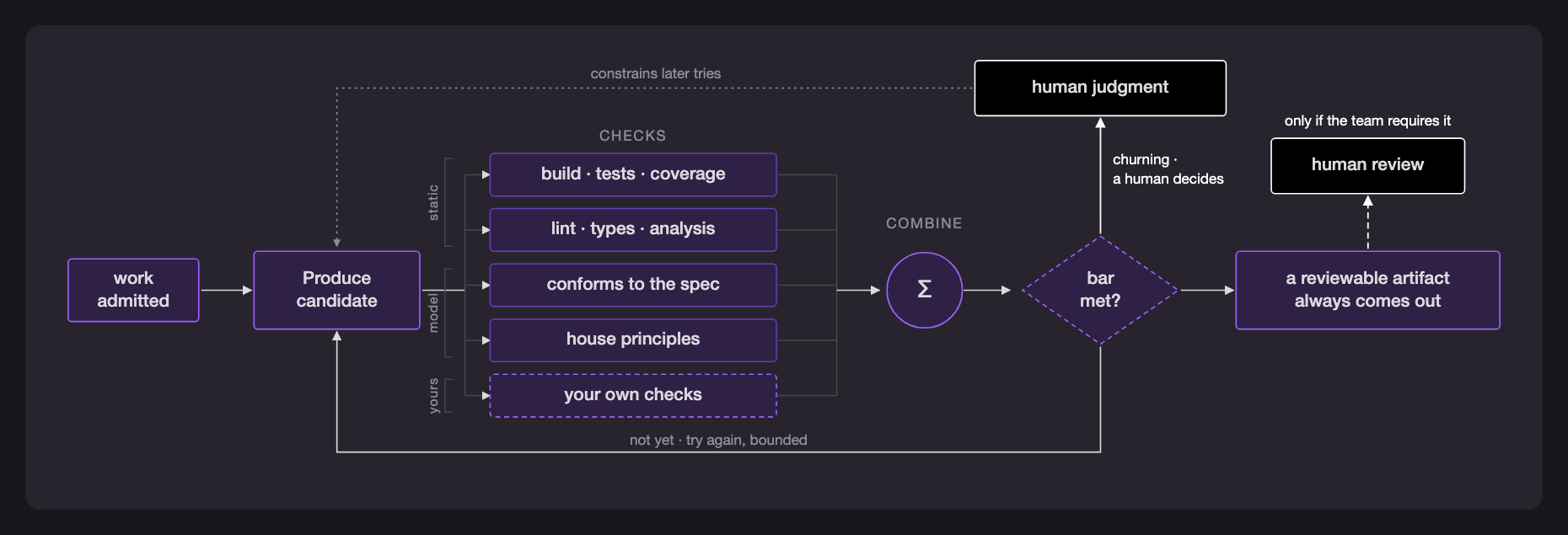
Whatever the outcome, the step leaves something a person can review. For a change, that’s the pull request and its verifiable output, a page written from the run’s own checks. It says what changed and why, the choices made and the alternatives weighed, and walks through how the change works with diagrams where they help. It also shows what each check found and what wasn’t run. Often a person reads that page rather than every line of code, and can rely on it because the checks behind it have already run.
Many of our days used to start with picking the next task or bug and handing it to an agent, one at a time, with some version of “good morning agent, please start on task XYZ.” Loops and workflows took a lot of the driving out of a single task, but someone still had to start them and keep an eye on them.
For the work the factory handles, that step is gone. Nobody creates a session, picks a ticket and hands it over. The factory picks up work from the board and comes to us when a decision is ours. It also finds its own work. Monitor raises follow-ups, and Discover puts them on the board next to what people file.
When the factory does need someone, it should pull them in at the right time, with the right context, so they can decide without rebuilding that context first. Its questions arrive as a comment on the board item or the pull request, where the team already works. Workers remember nothing between runs, so everything they need lives there too.
Running in the background also means favoring throughput over latency. Implement takes one item each time it’s scheduled, so any single item can take longer than doing it yourself. Latency still matters, and when something can’t wait, a person can start a worker on that one item. Most of the time, many items moving at once with nobody driving each one is the better trade.
This is how our team runs its instance of the Manual.
The Manual is built around Kiro and ships with Kiro CLI as its harness, and our workers run headless on it.
The rest is up to each team’s instance. Ours runs on a schedule in Lambda MicroVMs, so it keeps going whether or not anyone’s laptop is open. Items live on our task board, and changes go through pull requests and CI on GitHub.
Our skills teach each step how our team works. Implement checks each change against the invariants our architecture depends on, Release follows it through every Kiro client and channel it has to reach, and Monitor reads its production telemetry. We’ve also kept iterating on our status report. It now shows everything from what’s waiting on a person to how far each change has gotten in release, along with the evidence for which kinds of change could merge without a reviewer.
When working with the factory, the biggest change is in how we work. Less of our time goes to starting agents and checking on them, and more goes to deciding what’s worth building and whether it’s right. It’s early, and we haven’t solved this, but how we work has changed.
About 85% of the open items on our board already have a pull request, and they move forward while we work on something else. It also follows changes through release and checks afterwards whether they helped. We didn’t do that for every change before, and now it tells us what each change actually did and feeds what the factory learns.
Each pull request arrives with its checks and a description of what changed, and when the factory stops for a person it says what the decision is. We track how much the factory ships, but that isn’t what we watch most closely. We watch how often it needs one of us, and whether it was for the right reason.
Two tensions run through all of this. The first is safety. Kiro is production software that developers rely on every day, so human attention and escalations work as training wheels that limit how far a bad decision can spread. But the factory improves by learning from its mistakes, including ones that don’t show up right away, and it needs room to make them. The second is pace. A factory should keep things moving, but if it opens changes faster than the team can review and ship them, or stops to ask too often, it grinds itself to a halt.
On safety, the training wheels stay on for our main branch, and nothing ships without a person’s review. Once a person merges a change, Release follows it into the Kiro builds people use, and Monitor checks afterwards whether it helped. Our edge build is where the factory gets room to make mistakes. It’s an internal build of the product with changes that haven’t merged yet, including implementations built ahead of their design’s approval. Teammates can install it, but we mainly run it to see where the factory goes wrong and how quality holds as changes pile up.
On our board, 14% of open items are waiting on a decision the factory flagged for a person, and more than twice as many are waiting on a review we require before anything merges. The factory would have asked for some of those reviews anyway. For the rest, we’d rather earn trust in less review than assume it, so we set our instance’s goal around gathering evidence about which kinds of change could safely go without a reviewer.
On pace, we found that the factory was stopping to ask too often. The review loop in Implement escalated whenever rounds stopped converging, so a person got pulled in even when the choice could easily be reversed later, and the work sat until they answered. Now it settles choices that an ordinary change could undo, stating the choice and the alternative at the top of the pull request, and only escalates when a choice is hard to undo, like a change to persisted data, a public interface or security behavior.
Pace is still open. Spreading the decisions out means there are more of them, and they jump from one task to the next, often to something unrelated. Some days it feels like a homework generator for humans. Reviews got easier, but we still ask an agent to explain what the factory produced before we can decide on it.
The factory also doesn’t solve context and memory. Learn turns the corrections people make on board items and pull requests into skill changes, but most of what a good reviewer knows about the repo still lives in people’s minds, and that still pulls us back in. On a large existing repo, a new factory starts cold. It needs a durable representation of the codebase that goes beyond what skills and memory hold today, built from the code itself, and that’s a direction we’re exploring.
Today the factory takes on the one-off tasks and bugs in our backlog. Larger features that need to be designed and broken down first don’t go through it yet, and they’re what we want it to take on next. It’s also semi-automatic by choice. As evidence from our edge build accumulates, we expect to set autonomy per kind of change, and take the training wheels off for the kinds that have earned it, and we’ll write about what we find.
If this works, the factory reaches further on both ends. Upstream, it joins the product and UX discussions that fill the backlog, and takes on the larger features it can’t yet. Downstream, it works alongside operations on what ships. A person’s day moves from driving and checking agents to deciding and directing, and review narrows to the choices that need a person’s judgment. Agents do the work across the lifecycle, and everyone with a stake in it spends their time on the decisions only they can make. That’s what we’re building toward. We don’t know yet how far that goes, but every new model and Kiro release lets us push it further. This is how we do it today, and it’s still changing.
We’re publishing the Manual as open source at kirodotdev-labs/sample-kiro-factory-manual. Its board, code host and hosting are integrations you can point at your own.
Try it yourself today. Take a project you already have, point your agent at the factory-setup skill in the repo to write an instance with you, and give the factory a few items from your backlog to work through. You’ll need Kiro CLI, a GitHub repo and the GitHub CLI. Workers run on a schedule and use credits whether or not anyone is watching, so start small, and give the factory an account of its own with access to that repo only. The README covers setup and security in full. We’ll keep building and sharing what we learn, and we’d love to hear how it works for you on Discord.