This release gives V3 spec runs a full-screen task execution view with real-time progress and task scope selection. The new Preserve scrollback toggle keeps terminal history available through overflow and resize redraws.
Full-screen spec task execution (V3)
Run a spec with /spec run to open the dedicated full-screen task execution view. Follow progress in real time and choose the task scope before execution begins. Learn more ->
This release brings mouse support to the spec review screen. Under the hood, a stream idle watchdog, automatic retries with backoff, and a 60-minute streaming timeout mean a dropped connection or a throttled request no longer hangs or ends your turn.
Mouse support in spec review
The spec review screen now supports the mouse: scroll to navigate the document and click to position the cursor. Press m to toggle mouse support on or off. Learn more ->
Automatic recovery from stream and network failures
Turns no longer hang on a stalled response stream: an idle watchdog warns after 60 seconds of silence and cancels at 300, while throttling, 5xx errors, and connection drops are retried automatically with backoff. Streaming responses also get a 60-minute timeout by default, so long responses are no longer cut off. Tune all of it with the api.streamIdleSoftTimeout, api.streamIdleHardTimeout, and api.timeout settings. Learn more ->
This release lets you talk to Kiro instead of typing: /voice dictates your prompts with on-device transcription. Spec runs gain a review screen for reading phase documents and staging line comments, and AGENTS.md files now load as steering context from anywhere in your workspace tree. Enterprise administrators should note that cloud sessions are now opt-in, so organizations that never set the toggle will find them disabled.
/voice dictation
Speak your prompts instead of typing them. Start a recording with /voice or by holding Space, and partial text streams into the prompt as you talk until you press Enter or it auto-stops on silence. By default your speech is transcribed on your own machine with Whisper, so no audio leaves your computer and no cloud API key is required. The model downloads once, behind an explicit confirmation, on first use. Learn more ->
Cloud sessions are now opt-in (v3)
Cloud sessions are now disabled unless an administrator explicitly turns on Cloud Sessions in the Kiro console. Because an unset toggle now resolves to disabled, organizations that never configured it will find cloud sessions unavailable until an admin opts in. Learn more ->
Spec review screen (v3)
Press Ctrl+X at a spec phase checkpoint to read the phase document in place and stage line comments on the parts you want changed. When you answer the checkpoint question, every staged comment goes to the agent as one revision request, so reading a document and asking for changes stays in a single screen. Learn more ->
Nested AGENTS.md steering (v3)
AGENTS.md files now load as steering context from anywhere in your workspace tree, not just the workspace root and ~/.kiro/steering/. Put an AGENTS.md next to the code it describes, and the agent picks it up alongside your other steering files. Learn more ->
This release introduces cloud sessions in preview: run your session in a managed cloud sandbox with --cloud, disconnect while the agent keeps working, and resume from any machine. The slash command menu also gains substring matching, and typing in the TUI stays smoother during rapid input.
Cloud sessions (preview)
Cloud sessions let you run Kiro CLI in a managed cloud sandbox instead of on your machine. Start one with kiro-cli --cloud (or kiro-cli chat --cloud), attach repositories with --repo or the /repo picker, then disconnect while the agent keeps working and resume later from any machine with --resume-id. Cloud and local sessions appear together in the session picker. Learn more ->
For organizations using IAM Identity Center, administrators manage Cloud Sessions with the Cloud Sessions (Preview) setting, formerly Kiro Web (Preview). Organizations that enabled the prior setting remain enabled; new organizations must opt in before users can start Kiro Web sessions.
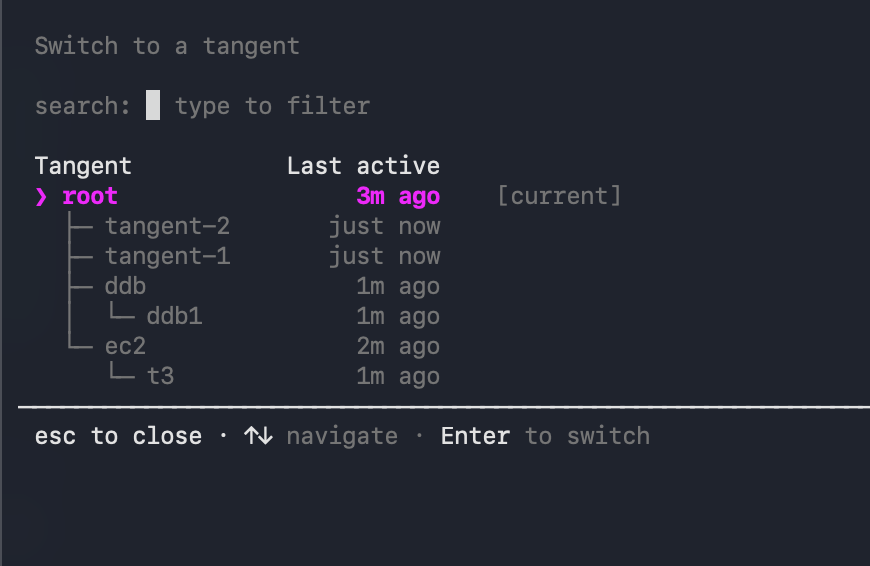
This release introduces tangents: branch into side-conversations that inherit your full conversation history, explore freely, then jump back exactly where you left off. /context also gains a per-tool token breakdown so you can see what's consuming your context window.
/tangent side-conversations (v3)
Loading image...
Need to look something up mid-task without polluting your main thread? /tangent branches into a side-conversation that inherits everything discussed so far — explore freely, then jump back to exactly where you left off. Create named tangents with /tangent <name>, browse your whole conversation tree in a visual picker with /tangent ls, and jump straight back to the main conversation from any depth with /tangent root. Available in V3 mode (kiro-cli --v3). Learn more ->
This version adds a guided description step to /spec new and makes Plan mode execute your approved plan automatically without a manual mode switch.
Guided spec creation (v3)
/spec new now asks what the spec should cover before drafting requirements. Instead of guessing from the spec name alone, the agent uses your description as the ground truth for the requirements it generates. Learn more ->
Plan auto-execution (v3)
In Plan mode, approving a plan now kicks off execution immediately. You no longer need to manually switch modes after reviewing and accepting the plan. Learn more ->
This release introduces /upgrade-agent to migrate V2 custom agent configurations to the universal format, automatic retries for interrupted model responses, and quality-of-life improvements across both modes.
/upgrade-agent (v3)
Migrate V2 agent configuration files to the universal format that works with both V2 and V3. Run /upgrade-agent inside a V3 session to convert your existing custom agent configs in place the command reads your V2 configuration and produces an updated file compatible with both modes. Available in V3 mode (kiro-cli --v3). Learn more ->
This release brings two new capabilities to CLI 3.0 (early access) a built-in subagent for learning Kiro's features and global hooks that apply across all workspaces alongside error handling fixes for all users.
Introspect Subagent (v3)
Ask questions about Kiro's features and get accurate answers in-line. The new introspect subagent can explain capabilities, walk you through writing custom agents, hooks, and steering files, and suggest the right configuration for your workflow. Available in V3 (kiro-cli --v3).
Global Hooks (v3)
Define hooks once and have them apply everywhere. Hooks placed in ~/.kiro/hooks/ now fire in every workspace automatically, so cross-cutting behaviors like linting on save, security checks before commits, or custom approval gates no longer need to be duplicated per project. Workspace-level hooks continue to work alongside global ones. Available in V3 (kiro-cli --v3).
MCP OAuth now supports servers with strict requirements, like Figma. Configure a client secret for servers that require one, point the redirect URI at a custom callback path, and skip Dynamic Client Registration when you bring your own client ID. This release also brings more accurate approval prompts for commands with combined flags, and full ASCII mode coverage for terminals without Unicode support.
MCP OAuth for Pre-Registered Apps
Connect to remote MCP servers that require a pre-registered OAuth app. Add clientSecret alongside clientId in your server's OAuth config for servers that require a client secret. When a custom clientId is set, Kiro skips Dynamic Client Registration and authenticates as your app. The redirectUri field now accepts full URLs with custom paths (like http://localhost:7778/oauth/callback), so your callback URL can match exactly what your app registered. Callback hosts are limited to localhost for safety. Learn more ->
This release adds dedicated commands for managing OAuth authentication on remote MCP servers, so you no longer need to restart sessions or manually clear credentials when auth flows get stuck. The /usage display also gets a refresh to reflect the new prepaid credits model.
MCP Authentication Management
Three new commands give you full control over OAuth credentials for remote MCP servers. /mcp auth forces re-authentication when a token has expired or become invalid, /mcp cancel-auth aborts a pending auth flow that's stuck waiting for browser confirmation, and /mcp logout removes stored credentials entirely. Keyboard shortcuts are also available in the MCP panel status view: ^A to force auth, ^X to abort, and ^R to remove credentials. Learn more ->